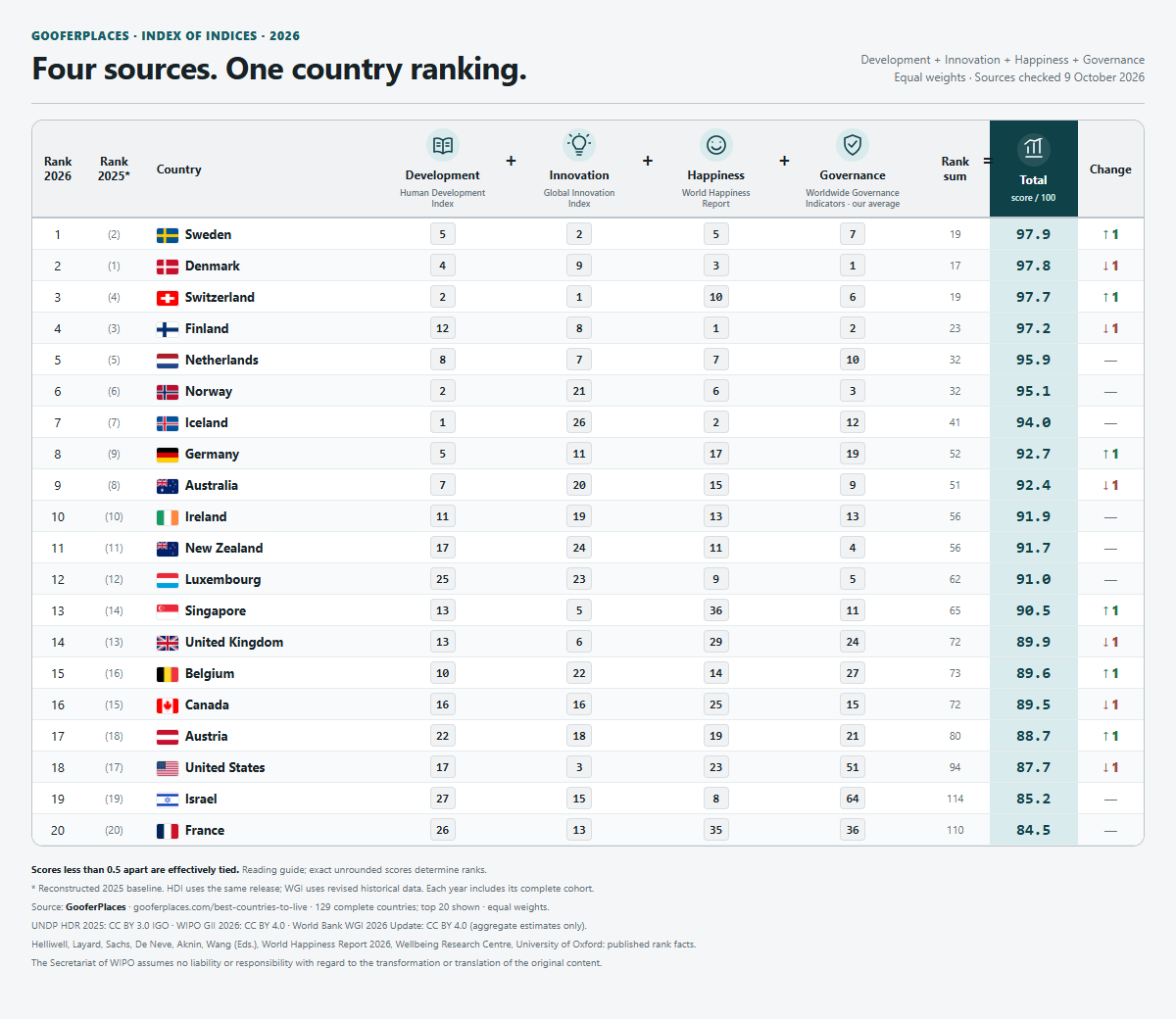
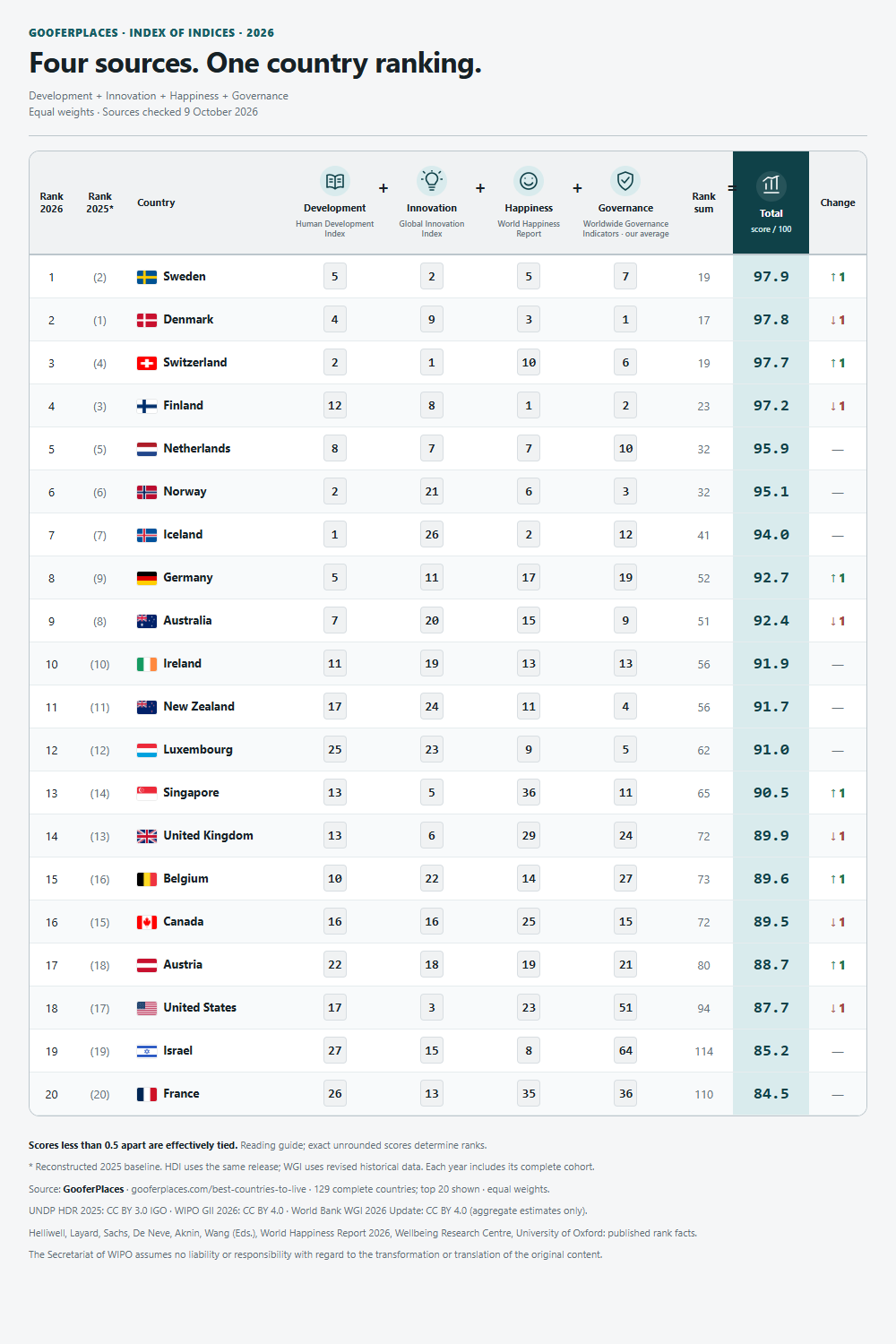
Sweden, Denmark, Switzerland, Finland and the Netherlands lead our 2026 Index of Indices, which gives equal weight to development, innovation, happiness and governance after converting each source rank to a 0–100 scale. Compare all 129 countries, inspect the original ranks, or adjust the weights to reflect your priorities.
129 countries · 4 sourcesEqual weights by defaultSources checked 9 October 2026How it works
The list of lists
One table. Four perspectives.
Source ranks stay visible. The highlighted score determines the order.
Adjust the weights Equal weights = 25% each
Use relative weights: 2 gives a pillar twice the influence of 1. A weight of 0 switches it off. Both years recalculate together.
Equal weights. Source ranks are unchanged.
Showing 20 of 129 countries
Scroll the table sideways to see every pillar and the total. The country column stays in view.
GooferPlaces Index of Indices 2026. Original source rank positions, rank sums, normalized scores and reconstructed 2025 comparison. Lower source ranks are better; higher total scores are better.
Rank 2026
Rank 2025*
Country
DevelopmentHuman Development Index
+InnovationGlobal Innovation Index
+HappinessWorld Happiness Report
+GovernanceWorldwide Governance Indicators
Rank sumfor reference
=Totalscore / 100
Changevs 2025*
1
(2)
Sweden
5
2
5
7
19
97.9
↑ 1
2
(1)
Denmark
4
9
3
1
17
97.8
↓ 1
3
(4)
Switzerland
2
1
10
6
19
97.7
↑ 1
4
(3)
Finland
12
8
1
2
23
97.2
↓ 1
5
(5)
Netherlands
8
7
7
10
32
95.9
—
6
(6)
Norway
2
21
6
3
32
95.1
—
7
(7)
Iceland
1
26
2
12
41
94.0
—
8
(9)
Germany
5
11
17
19
52
92.7
↑ 1
9
(8)
Australia
7
20
15
9
51
92.4
↓ 1
10
(10)
Ireland
11
19
13
13
56
91.9
—
11
(11)
New Zealand
17
24
11
4
56
91.7
—
12
(12)
Luxembourg
25
23
9
5
62
91.0
—
13
(14)
Singapore
13
5
36
11
65
90.5
↑ 1
14
(13)
United Kingdom
13
6
29
24
72
89.9
↓ 1
15
(16)
Belgium
10
22
14
27
73
89.6
↑ 1
16
(15)
Canada
16
16
25
15
72
89.5
↓ 1
17
(18)
Austria
22
18
19
21
80
88.7
↑ 1
18
(17)
United States
17
3
23
51
94
87.7
↓ 1
19
(19)
Israel
27
15
8
64
114
85.2
—
20
(20)
France
26
13
35
36
110
84.5
—
No matching country. Try another name.
Scores less than 0.5 apart are effectively tied. This is a reading guide, not a statistical confidence test; unrounded scores still determine the displayed ranks.
* Change is compared with a reconstructed 2025 baseline. HDI uses the same release in both years; WGI uses revised historical data. Each year includes its complete-country cohort, so entry or exit can affect ranks. “New” means the country was not in the 2025 cohort.
The governance rank is calculated by GooferPlaces. Source ranks stay fixed when weights change; the rank sum becomes a weighted sum.
Methodology · standard of living and its limits
How the four ranks become one score
Every pillar, the same scale
100 × (N − rank) / (N − 1)
N is that source’s full country/economy count before our coverage filter: HDI 193, GII 139, WHR 147 and governance 206 for 2026. Governance’s 2025 comparison uses 208.
We start with equal weights: development, innovation, happiness and governance each contribute 25%. The total is their average normalized rank score. Custom weights change their relative contributions. Higher total scores are better.
The governance rank is our own average of the six WGI dimensions: voice and accountability; political stability and absence of violence/terrorism; government effectiveness; regulatory quality; rule of law; and control of corruption. We average their same-year estimates and rank the complete source economies. World Bank publishes these dimensions separately, without this overall rank.
No missing values are estimated. Every ranked country needs all four sources, including all six WGI dimensions. The 2026 table has 129 complete countries; the reconstructed 2025 cohort also has 129, with 127 in common.
The rank sum is shown for reference: add the four original ranks, or their weighted ranks after an adjustment. Lower is better. We use the normalized score as the headline because the sources cover different numbers of countries. Original ties are retained; exact unrounded totals decide the composite order.
The Netherlands HDI rank conflict
UNDP’s official machine-readable CSV and XLSX both say 8, while its standalone Table 1 PDF says 9. We use 8, matching both machine-readable files, and disclose the disagreement. The same observed-2023 HDI release is used in both composite years; UNDP warns that revised values from different reports are not directly comparable.
Unlike some list-of-lists rankings, we leave out the IMD competitiveness ranking because its data is not openly licensed; we use World Bank governance instead.
HDI covers health, education and income; GII measures innovation; WHR measures surveyed life evaluations; WGI reflects governance perceptions. These inputs can correlate. The table does not cover visas, personal taxes, housing budgets, language or climate preferences, and a close rank difference is not proof of a meaningful change in daily life.
Read the leading countries’ results
Equal-weight rank 1 · 97.9 / 100
Sweden
Sweden combines second place in innovation with fifth in development and happiness, and seventh in our derived governance ranking. Its balanced source positions put it first under equal weights, up from second in the reconstructed comparison. Choosing a city still requires separate housing and work evidence.
Denmark leads our derived governance ranking and places third in happiness. Its innovation position is ninth, so it finishes just behind Sweden under the normalized equal-weight method. The small score gap is best read as a close result, rather than a decisive difference in daily life.
Switzerland leads innovation and shares second place in development. Happiness is tenth, a lower relative position than its other pillars. It ranks third in this composite and fourth in the reconstructed baseline. Its country-level result does not settle practical housing or affordability choices.
Finland leads the published happiness ranking and is second in our derived governance ranking. Development is twelfth and innovation eighth. These four relative positions place it fourth overall, compared with third in the reconstructed baseline. The happiness ranking describes surveyed residents, not a guarantee for an individual move.
The Netherlands has development rank 8, innovation rank 7, happiness rank 7 and derived governance rank 10. It remains fifth in both equal-weight editions. Those national positions do not decide between Amsterdam and Rotterdam: local housing and travel choices still matter. The HDI source-file conflict is explained below.
These 68 countries in our existing country catalogue are missing one or more required source inputs for 2026. An exclusion does not mean a low score. The missing source is named for each country.
Source files and terms were checked on 9 October 2026. GooferPlaces normalizes rank positions and combines them; source organizations have not endorsed this ranking. Source-specific rights apply, with no blanket licence claimed for the combined table.
UNDP (United Nations Development Programme). 2025. Human Development Report 2025: A matter of choice: People and possibilities in the age of AI. Human Development Report Office. Observations: 2023, unchanged in both composite editions.
World Intellectual Property Organization (WIPO) (2026). Global Innovation Index 2026: Powering entrepreneurs at the frontier of science, 19th edition. Geneva: WIPO. DOI: 10.34667/tind.59194. 2026 report.
Comparison: World Intellectual Property Organization (WIPO). Global Innovation Index 2025: Innovation at a Crossroads, 18th edition. Geneva: WIPO. DOI: 10.34667/tind.58864. 2025 report · Copyright. The suggested citation’s 2024 date conflicts with the 2025 title/copyright; we identify the edition without asserting that date.
Only published overall ranks are used, with normalization and composite calculations by GooferPlaces; no underlying third-party indicators are reused. The Secretariat of WIPO assumes no liability or responsibility with regard to the transformation or translation of the original content.
WHR · World Happiness Report
Published rank facts · cited
Helliwell, J. F., Layard, R., Sachs, J. D., De Neve, J.-E., Aknin, L. B., & Wang, S. (Eds.). (2026). World Happiness Report 2026. University of Oxford: Wellbeing Research Centre. Surveys: 2023–2025. 2026 report.
Comparison: Helliwell, J. F., Layard, R., Sachs, J. D., De Neve, J.-E., Aknin, L. B., & Wang, S. (Eds.). (2025). World Happiness Report 2025. University of Oxford: Wellbeing Research Centre. Surveys: 2022–2024. 2025 report.
Official data-sharing page. We use factual published country rank positions only, with full citation. No explicit commercial open-data licence is claimed; no source charts, prose, life-evaluation scores or explanatory factors are reproduced.
World Bank. 2026. Worldwide Governance Indicators, 2026 Update: Governance Estimates and Scores (1996–2025). Data resource DR0095947, retrieved 9 October 2026. Current observations: 2025; comparison: revised 2024 from the same release.
Official dataset catalogue · Licence terms · Usage advisory. GooferPlaces calculates the mean, derived rank and normalized composite from the six aggregate estimates. Restricted underlying provider values are excluded. Small differences may fall within model uncertainty; the derived mean has no claimed confidence interval.
Questions
Reading the ranking
What does a high score mean?
A high score means strong relative positions across the four selected sources, with equal weights by default. It is a normalized rank score, not a percentage of life satisfaction or a prediction of your experience. Visas, housing costs, language, climate and your own circumstances can change where you would choose to live.
Why is a country not ranked?
A country needs a published rank in HDI, GII and WHR, plus all six governance estimates for the relevant year. If any input is missing, we exclude it rather than estimate a replacement. The “Not ranked this year” section names the missing sources for every excluded country in our existing catalogue.
What does the 2025 rank compare with?
The 2025 column is a reconstructed baseline, using GII 2025, WHR 2025, the same HDI release and revised WGI historical data. Each year includes its complete countries. “New” marks a country absent from the earlier cohort. Movement is relative and may reflect source revisions or coverage changes, rather than an absolute improvement.
Can I change the weights?
Yes. Open “Adjust the weights” to change the relative importance of each pillar. The 2026 and reconstructed 2025 rankings recalculate together; source ranks remain unchanged. A weight of zero disables a pillar, but complete four-source coverage is still required. Reset restores equal weights, and Share weights gives you a reusable URL.
Share & cite
Share the equal-weight ranking
The images use the default ranking, with equal weights. Use “Share weights” above for a custom interactive view.
<a href="https://gooferplaces.com/best-countries-to-live"><img src="https://gooferplaces.com/index-of-indices/ranking-2026-landscape.png" alt="GooferPlaces Index of Indices 2026: equal-weight country ranking" width="1200" style="max-width:100%;height:auto"></a>
<p>Source: <a href="https://gooferplaces.com/best-countries-to-live">GooferPlaces</a></p>
Cite this ranking
GooferPlaces. Index of Indices 2026, based on UNDP HDI, WIPO GII, World Happiness Report published rank facts and World Bank WGI. Sources retrieved 9 October 2026. gooferplaces.com/best-countries-to-live.



 Sweden
 Afghanistan
 Andorra
 Angola
 Antigua & Barbuda
 Bahamas
 Barbados
 Belarus
 Belize
 Bhutan
 Brunei
 Burundi
 Cape Verde
 Central African Republic
 Comoros
 Congo - Brazzaville
 Cuba
Cuba Djibouti
 Dominica
 Equatorial Guinea
 Eritrea
 Eswatini
 Fiji
Fiji Gabon
Gabon Gambia
 Grenada
 Guinea
 Guinea-Bissau
 Guyana
 Haiti
Haiti Iraq
Iraq Kiribati
 Kosovo
 Liberia
 Libya
Libya Liechtenstein
 Maldives
 Marshall Islands
 Micronesia
 Monaco
 Nauru
Nauru North Korea
 Palau
Palau Palestinian Territories
 Papua New Guinea
 Qatar
Qatar Rwanda
 Samoa
Samoa San Marino
 Seychelles
 Sierra Leone
 Solomon Islands
 Somalia
 South Sudan
 St. Kitts & Nevis
 St. Lucia
 St. Vincent & Grenadines
 Sudan
Sudan Suriname
 Syria
Syria São Tomé & Príncipe
 Taiwan
 Timor-Leste
 Tonga
Tonga Turkmenistan
 Tuvalu
 Vanuatu
 Vatican City
 Yemen
Yemen