Temperature
July has the warmest monthly average (28.9°C); January is coolest (2.5°C). These averages include nights, so daytime highs can be considerably warmer.

Iran · Visit or make it home
Isfahan is a city in Iran. Compare its dated local facts and monthly climate before choosing a time to visit or planning a move. Housing references and national earnings describe different populations; verify the costs of your own home and job before deciding.
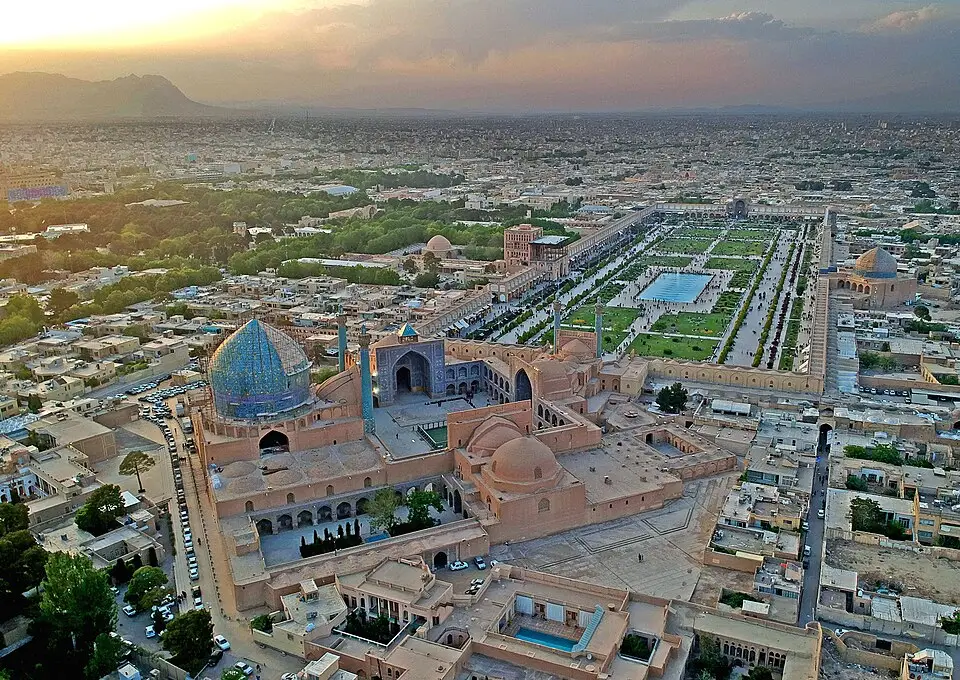
Get to know Isfahan
Isfahan is a city in the Central District of Isfahan County, Isfahan Province, Iran. It is the capital of the province, the county, and the district. It is located 440 kilometres south of Tehran. The city has a population of approximately 2,238,000, making it the third-most populous city in Iran, after Tehran and Mashhad, and the second-largest metropolitan area. Isfahan is located at the intersection of the two principal routes that traverse Iran, north–south and east–west. Isfahan flourished between the 9th and 18th centuries. Under the Safavid Empire, Isfahan became the capital of Iran, for the second time in its history, under Abbas the Great. It is known for its Persian–Muslim architecture, grand boulevards, covered bridges, palaces, tiled mosques, and minarets. Isfahan has many historical buildings, monuments, paintings, and artifacts. The fame of Isfahan led to the Persian proverb Esfahān nesf-e-jahān ast . Naqsh-e Jahan Square in Isfahan is one of the largest city squares in the world, and a UNESCO World Heritage Site.
Weather through the year
July has the warmest monthly average (28.9°C); January is coolest (2.5°C). These averages include nights, so daytime highs can be considerably warmer.
March averages about 28 mm of rain, compared with 1 mm in July. Rainfall alone does not identify a single best month; compare temperatures with the activities you plan.
April, May, October combine monthly mean temperatures of 12–22°C with less than 100 mm of precipitation. These are useful dates to compare for a walking-focused visit; check daylight, opening times and the forecast for your actual trip.
Monthly mean temperatures reach at least 25°C in June, July, August. For sightseeing, plan shade, water breaks and accommodation cooling into your day; daytime temperatures can be higher than these day-and-night averages.
January, February, December have monthly means below 5°C. For a stay then, compare accommodation heating and keep indoor options in your itinerary. These figures do not establish snow cover or ski conditions.
| Month | Jan | Feb | Mar | Apr | May | Jun | Jul | Aug | Sep | Oct | Nov | Dec |
|---|---|---|---|---|---|---|---|---|---|---|---|---|
| Average °C | 2.5 | 4.7 | 9.3 | 14.5 | 20.9 | 26.6 | 28.9 | 27.3 | 23.2 | 17.1 | 8.7 | 4.0 |
| Rain, mm | 23 | 20 | 28 | 26 | 10 | 2 | 1 | 1 | 1 | 4 | 24 | 26 |
Source: NASA POWER climatology · Reference period: 2001-2020. Long-term averages for the surrounding grid area. Conditions vary within a city; monthly averages are neither a forecast nor a guarantee of dry days.
Build your shortlist for a day out. Distances are straight-line from the city centre; check routes and opening times before setting off.
Forest
6.6 km from the city centre
Compare with another cityMuseum
Less than 1 km from the city centre
Compare with another cityPark
1.4 km from the city centre
Compare with another cityA verified average rent for Isfahan is not available in the evidence shown here. Do not substitute another city’s price or a national estimate. Compare current properties for the same home size and neighbourhood, then include utilities, deposits and daily transport when building a budget for a visit or move.
A verified city average salary for Isfahan is not available in the evidence shown here. National income per person and purchasing-power measures are not salaries and cannot predict take-home pay. Compare a current offer in your occupation with local taxes, housing and transport costs before deciding whether a move is affordable.
Compare the same dated measures for both cities, keeping local observations separate from national context. Start with rent, your expected income and the journeys you will make regularly. Then adjust the comparison weights to your priorities. Missing measurements do not prove an advantage; verify decisive costs and services with current local sources.
Data sources, licences & reuse terms
Plan your stay
Compare accommodation for your actual dates in Isfahan, then add the journey here, airport transfers, meals and the activities you want. A cheap room outside the centre can cost more overall if it adds daily transport.
Compare holiday preferences →Use the planner below to compare housing, daily spending and the cost of your move.
Include the deposit, utilities, internet and commuting. Compare those costs with your own expected take-home income.
Compare with another city →Build a monthly budget for Isfahan in euros. Totals are calculated from the amounts below, not live quotes. Enter a housing amount for your chosen home.
Monthly total:
First month including move:
Compare with another city →Compare the details
165 mm/year
Annual precipitation gives a broad climate comparison. Its distribution through the year matters more for a short visit.
Source: NASA POWER — climatology (T2M temperature; PRECTOTCORR precipitation) · NASA scientific-data policy; source-specific notices applyCompare with another city →15.7 C
Long-term average including days and nights. Use the monthly breakdown to choose dates; this is not a weather forecast.
Source: NASA POWER — climatology (T2M temperature; PRECTOTCORR precipitation) · NASA scientific-data policy; source-specific notices applyCompare with another city →4.1 km
Straight-line distance to a listed airport, not transfer time or confirmation of scheduled flights. Check the airport serving your actual route before booking.
Data period: 2026-08-30. Source: OurAirports — airport locations · Public domainCompare with another city →These are country-level figures, not measurements of Isfahan. Use them to compare national conditions; neighbourhoods, salaries and individual services can differ substantially.
19,660 international dollars (PPP)
Purchasing-power-adjusted national income per person is not a salary or take-home pay.
Data period: 2025. Source: World Bank — GNI per capita, PPP (NY.GNP.PCAP.PP.CD) · CC BY 4.0 with World Bank additional termsCompare with another city →85.3 percent
Data period: 2024. Source: World Bank / ITU — Individuals using the Internet, % (IT.NET.USER.ZS) · CC BY 4.0 with World Bank additional termsCompare with another city →77.9 years
Life expectancy describes population health outcomes; it does not measure the quality or availability of a particular hospital.
Data period: 2024. Source: World Bank — Life expectancy at birth (SP.DYN.LE00.IN) · CC BY 4.0 with World Bank additional termsCompare with another city →40 ordinal_0_100
Data period: 2026-08-30. Limited confidence. Source: Wikidata — coordinates, population, timezone, ISO codes, official languages · CC0 1.0Compare with another city →7.4 percent_gdp
Taxes and social contributions as a share of the economy, not your personal income-tax rate.
Data period: 2009. Older figure — excluded from recommendations. Limited confidence. Source: World Bank — Tax revenue % of GDP (GC.TAX.TOTL.GD.ZS) · CC BY 4.0 with World Bank additional termsCompare with another city →2.4 per 100,000 people
Homicide rates are a narrow safety indicator. They do not describe petty crime or the safety of an individual neighbourhood.
Data period: 2014. Limited confidence. Source: World Bank / UNODC — Intentional homicides per 100k (VC.IHR.PSRC.P5) · CC BY 4.0 with World Bank additional termsCompare with another city →28.2 (EU average = 100)
Data period: 2025. Limited confidence. Source: World Bank — Price level index, household consumption (PA.NUS.PRVT.PLI) · CC BY 4.0 with World Bank additional termsCompare with another city →40.2 µg/m³
Data period: 2023. Limited confidence. Source: World Bank — PM2.5 mean annual exposure (EN.ATM.PM25.MC.M3) · CC BY 4.0 with World Bank additional termsCompare with another city →120.3 points (0–188)
Data period: 2025. Estimate. Source: World Bank HCI+ education pillar (2025) · CC BY 4.0 with World Bank additional termsCompare with another city →Comparable figures are not available here for: Seismic hazard (ordinal 0 very-low to 4 high); Public-transport provision (ordinal proxy); Distance to nearest sea / coastline; Distance to nearest mountains (>1500 m); Monthly rent, 1-bedroom, city centre; Annual sunshine hours. Check the items that affect your plans with local providers. They are not treated as zero or as an advantage in recommendations.
Read the source dates, choose your priorities and keep unavailable values separate from costs you know.
All maintained comparisons →