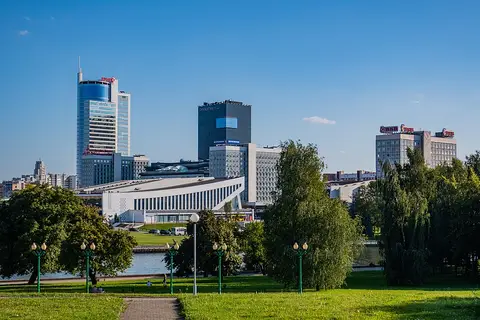
Minsk →
Compare Minsk for seasonal weather, housing and everyday journeys.

Explore the country
Belarus provides national context for a visit or move. Read its sourced introduction and dated national indicators, then compare individual cities for seasonal weather, housing and daily journeys. National averages cannot establish the costs, services or conditions of a particular neighbourhood.
Compare relocation preferencesBelarus, officially the Republic of Belarus, is a landlocked country in Eastern Europe. It is bordered by Russia to the east and northeast, Ukraine to the south, Poland to the west, and Lithuania and Latvia to the northwest. Belarus spans an area of 207,600 square kilometres with a population of 9.1 million. The country has a hemiboreal climate and is administratively divided into six regions. Minsk is the capital and largest city; it is administered separately as a city with special status. For most of the medieval period, the lands of modern-day Belarus were ruled by independent city-states such as the Principality of Polotsk. Around 1300 these lands came fully under the Grand Duchy of Lithuania and subsequently by the Polish–Lithuanian Commonwealth; this period lasted for 500 years until the 1792–1795 partitions of Poland-Lithuania placed Belarus within the Russian Empire for the first time.
A sourced introduction is available. The guide shows dated values for 9 distinct national indicators below, with source and confidence notes.
Comparable national figures are missing here for: Net annual earnings (single, no children); Household electricity price (band DC, all taxes); Average gross monthly earnings — country reference; Typical monthly rent, 1-bedroom, national. Missing values are not treated as zero and do not establish an advantage.
Available does not mean current or complete: older figures, estimates and limited confidence remain labelled beside each observation. National averages cannot establish neighbourhood costs or services. Check the dates and the sources for the decisions that matter to you.
Open a city guide for its local introduction, monthly climate and sources.
Compare Minsk for seasonal weather, housing and everyday journeys.
National averages are a starting point, not a neighbourhood budget. Shortlist specific places in Belarus, compare housing for your dates and check the journey to work, school or the activities that matter to you.
For a move, confirm residence and work requirements with the relevant government authority for your nationality. For a holiday, compare transport, accommodation and daily spending separately.
These figures describe Belarus as a whole. Check the dates when comparing these national indicators with current local conditions.
2.4 per 100,000 people[1]
Homicide rates are a narrow safety indicator. They do not describe petty crime or the safety of an individual neighbourhood.
Data period: 2019. Compare with another city →94.3 percent[2]
Data period: 2024. Compare with another city →36.7 (EU average = 100)[3]
Data period: 2025. Limited confidence. Compare with another city →34,310 international dollars (PPP)[4]
Purchasing-power-adjusted national income per person is not a salary or take-home pay.
Data period: 2025. Compare with another city →12 µg/m³[5]
Data period: 2023. Limited confidence. Compare with another city →74.4 years[6]
Life expectancy describes population health outcomes; it does not measure the quality or availability of a particular hospital.
Data period: 2024. Compare with another city →13 percent_gdp[7]
Taxes and social contributions as a share of the economy, not your personal income-tax rate.
Data period: 2024. Compare with another city →40 ordinal_0_100[8]
Data period: 2026-08-30. Limited confidence. Compare with another city →145.5 points (0–188)[9]
Data period: 2025. Estimate. Compare with another city →Sources and notes
Rankings: Which countries have the most doctors per 1,000 people? · Which countries have the lowest fertility rates? · Which countries have the highest internet use? · Which countries have the highest share of arable land? · Which countries have the highest inflation?