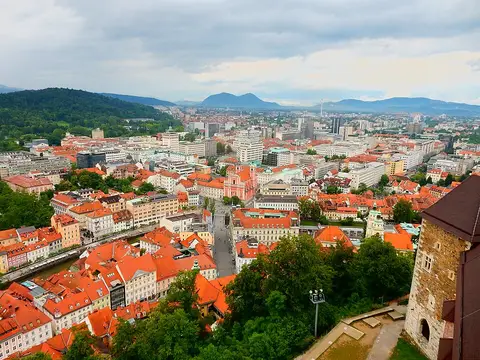
Ljubljana →
Compare Ljubljana for seasonal weather, housing and everyday journeys. Open its guide for the local introduction, monthly climate and sources.

Explore the country
Slovenia provides national context for a visit or move. Read its sourced introduction and dated national indicators, then compare individual cities for seasonal weather, housing and daily journeys. National averages cannot establish the costs, services or conditions of a particular neighbourhood.
Compare relocation preferencesSlovenia, officially the Republic of Slovenia, is a country in Central Europe. It borders Italy to its west, Austria to its north, Hungary to its northeast, and Croatia to its south and southeast; its southwestern boundary consists of a 46.6-kilometre coastline on the Adriatic Sea. The country is mostly mountainous and forested, covering 20,271 square kilometres . Its population is approximately 2.1 million people. Slovene is the official language. Slovenia has a predominantly temperate continental climate, with the exception of the Slovene Littoral and the Julian Alps. Ljubljana, the capital and largest city, is geographically situated near the centre of the country. Other urban centers include Maribor, Ptuj, Kranj, Celje, Koper, Novo Mesto, Velenje, Nova Gorica, Sežana, Murska Sobota, and Jesenice. The region has a long history of settlement. Proto-Illyrian tribes settled the area during the Early Bronze Age, stretching from present-day Albania to the city of Trieste, while the Slavic tribes arrived in the 5th century AD.
Compare Ljubljana for seasonal weather, housing and everyday journeys. Open its guide for the local introduction, monthly climate and sources.
National averages are a starting point, not a neighbourhood budget. Shortlist specific places in Slovenia, compare housing for your dates and check the journey to work, school or the activities that matter to you.
For a move, confirm residence and work requirements with the relevant government authority for your nationality. For a holiday, compare transport, accommodation and daily spending separately.
These figures describe Slovenia as a whole. Check the dates when comparing these national indicators with current local conditions.
22,503.2 €/year
An annual earnings reference for the stated household model, not a promised salary or a measure of your personal take-home pay.
Data period: 2025. Source: Eurostat — Annual net earnings (earn_nt_net) · Eurostat attribution reuse termsCompare with another city →89.5 (EU average = 100)
Data period: 2024. Source: Eurostat — Price level indices, household final consumption (tec00120 / prc_ppp_ind_1) · Eurostat attribution reuse termsCompare with another city →0.2 EUR/kWh
Data period: 2025-S1. Source: Eurostat — Electricity prices for household consumers (nrg_pc_204) · Eurostat attribution reuse termsCompare with another city →0.6 per 100,000 people
Homicide rates are a narrow safety indicator. They do not describe petty crime or the safety of an individual neighbourhood.
Data period: 2022. Source: Eurostat — Police-recorded offences by category (crim_off_cat) · Eurostat attribution reuse termsCompare with another city →81.8 years
Life expectancy describes population health outcomes; it does not measure the quality or availability of a particular hospital.
Data period: 2023. Source: Eurostat — Life expectancy at birth (tps00205 / demo_mlexpec) · Eurostat attribution reuse termsCompare with another city →96 index
Data period: 2022. Source: Eurostat — Number of foreign languages known, self-reported (edat_aes_l21) · Eurostat attribution reuse termsCompare with another city →79.6 pct_hh_vhcn
Data period: 2024. Source: Eurostat — Broadband internet coverage by technology (isoc_cbt) · Eurostat attribution reuse termsCompare with another city →16.1 µg/m³
Data period: 2017. Limited confidence. Source: World Bank — PM2.5 air pollution, mean annual exposure (EN.ATM.PM25.MC.M3) · CC BY 4.0 with World Bank additional termsCompare with another city →830 €/month
Index-based estimate, not observed rent
Data period: 2024. Limited confidence. Source: Deloitte Property Index 2025 (14th edition) — 'Average Monthly Rent per sqm in EUR, 2024' (77 cities) · Deloitte copyright / restricted website termsCompare with another city →58,880 international dollars (PPP)
Purchasing-power-adjusted national income per person is not a salary or take-home pay.
Data period: 2025. Source: World Bank — GNI per capita, PPP (NY.GNP.PCAP.PP.CD) · CC BY 4.0 with World Bank additional termsCompare with another city →38.6 % of GDP
Taxes and social contributions as a share of the economy, not your personal income-tax rate.
Data period: 2024. Source: Eurostat — Main national accounts tax aggregates (gov_10a_taxag) · Eurostat attribution reuse termsCompare with another city →3,694.4 USD/month
Average employee pay before tax and deductions, in US dollars. This country reference is not a city-specific salary or personal take-home pay.
Data period: 2025. Source: ILO — Average gross monthly earnings of employees · CC BY 4.0 (ILO datasets published from 3 May 2023)Compare with another city →152 points (0–188)
Data period: 2025. Estimate. Source: World Bank HCI+ education pillar (2025) · CC BY 4.0 with World Bank additional termsCompare with another city →